
About MMUF
Established in the 1988/1989 academic year, the Mellon Mays Undergraduate Fellowship (MMUF) is committed to broadening the range of scholarly perspectives in the US academy, with a focus on the humanities and the humanistic social sciences.
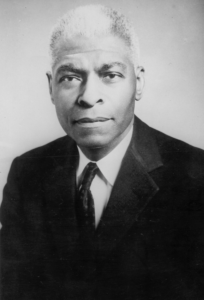 Its name honors Dr. Benjamin E. Mays, the noted African American educator, statesman, minister, and former president of Morehouse College. Benjamin Elijah Mays was born in 1895 in South Carolina, to parents who had been born into slavery and freed at the end of the Civil War. Mays excelled as a student from an early age, and was driven throughout his youth by what he termed “an insatiable desire to get an education.” Beginning in a one-room rural schoolhouse, he eventually entered Bates College stating “For the first time…I felt at home in the universe.” Mays went on to earn his master’s degree in 1925 and his doctorate in 1935. From 1934 to 1940, Mays served as dean of the Howard University School of Religion and then became president of Morehouse College, a position he held with distinction for the next quarter of a century. Mays spoke early and often against segregation and for education. He was a model for one of his Morehouse students, Martin Luther King, Jr., and he served as an unofficial senior advisor to the young minister. Mays gave the closing benediction at the 1963 March on Washington, as well as the eulogy at King’s funeral.
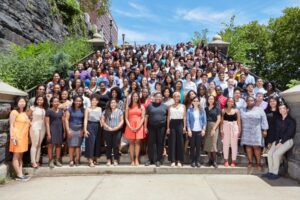
Each year, new MMUF undergraduate fellows are selected from applicants in the rising junior classes of MMUF member institutions. These fellows join the rising and graduating senior fellows in their institution’s MMUF program, where they are provided with mentoring and financial support as they prepare for entry into PhD programs and eventual careers as scholars and faculty members. The MMUF program also supports fellows enrolled in PhD programs in eligible fields through a suite of programmatic events and grant opportunities. This support continues beyond graduate school into fellows’ postdoctoral and faculty careers.
Thus far the program has produced more than 1,200 PhDs, more than 800 of whom are currently college professors and 300 of whom have taken their humanities training into venues ranging from museums and nonprofit organizations to publishing houses and government positions. At any given time, about 800 MMUF fellows are enrolled in PhD programs, while the fellowship supports approximately 500 undergraduate students each year.