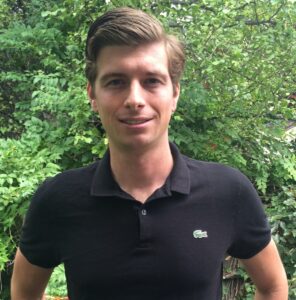
CCMS Colloquium invites you to a talk by Braxton Osting (University of Utah)
Title: Blood pressure monitoring with biophysics-informed machine learning models
Abstract: Measurement of blood pressure (BP) is essential for early diagnosis and management of hypertension, a condition that 45% of US adults have and a risk factor for development of heart failure, the leading cause of death in the US. Wearable technologies have the potential to transform BP monitoring by providing continuous assessments of cardiovascular health metrics and guiding clinical management. However, existing cuffless wearable devices for BP monitoring often rely on methods lacking theoretical foundations, such as pulse wave analysis or pulse arrival time, making them vulnerable to physiological and experimental confounders that undermine their accuracy and clinical utility. We developed a smartwatch device with real-time electrical bioimpedance (BioZ) sensing for cuffless hemodynamic monitoring. We elucidate the biophysical relationship between BioZ and BP via a multiscale analytical and computational modeling framework, and identify physiological, anatomical, and experimental parameters that influence the pulsatile BioZ signal at the wrist. A signal-tagged physics-informed neural network incorporating fluid dynamics principles enables calibration-free estimation of BP and radial and axial blood velocity. We successfully tested our approach with healthy individuals at rest and after physical activity including physical and autonomic challenges, and with patients with hypertension and cardiovascular disease in outpatient and intensive care settings. Our findings demonstrate the feasibility of BioZ technology for cuffless BP and blood velocity monitoring, addressing critical limitations of existing cuffless technologies.
Bio: Braxton Osting is a Professor in the Department of Mathematics at the University of Utah where he works on mathematical challenges in the natural and applied sciences. He has broad interests in analytical and computational methods for problems in applied mathematics, especially in optimization, partial differential equations, computational geometry, and machine learning.
After attending the University of Washington for his undergraduate studies, Braxton earned a Ph.D. in Applied Mathematics at Columbia University. Before moving to Utah, he was an NSF Postdoctoral Fellow in the Department of Mathematics at the University of California, Los Angeles.
In his free time, Braxton enjoys biking, skiing, running, hiking, and generally spending time outdoors.