
Design for Belonging: Advanced HCD Partners with Hiki
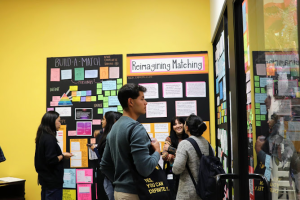
In Spring 2026, our Advanced HCD class, taught by Dr. Susie Wise, partnered with Hiki, a friendship and dating app for the Neurodivergent (ND) community built with and by ND adults, to ensure Hiki reflects ND needs. Hiki was created by Jamil Karriem, a Pomona alum who built the app because he believes that:
“Community is everything. For historically marginalized populations that experience the world differently, affinity-specific spaces can create a lot of safety. Being able to connect with other ND adults who live on the opposite side of the world (or next door), but have auniquely shared experience, is a really powerful and affirming tool. There’s a shared language and shared understanding that makes people feel less alone, makes people feel seen, and makes people feel whole.”
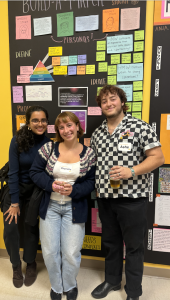 The students were challenged to redesign the app’s matching process to build more engaging connections between ND people, since traditional swiping mechanisms don’t align with how ND people think. Using the HCD process, students found that Hiki users desired authentic, patient connections that the performative, rushed nature of digital matching disables. Through Adv. HCD’s theoretical underpinnings of designing for belonging, they delivered two prototypes: HikiBloom and HikiOrbit. HikiBloom is a function that lets users send flowers to signal growing connections, with the hope of creating a digital garden that lowers the stakes of making a match outright. HikiOrbit used an existing Hiki feature, Circles, and uses co-presence as a metric of intimacy, allowing people to connect when they were in the same ‘place’ or Circle more than once.
Dr. Susie Wise noted that the Hiki team connected students with Hiki users so their empathy-building and prototype-testing were grounded in the reality of real people’s lives, rather than in assumptions about ND people and their needs. The Hive seeks to give students real-world experience in industry working through ambiguous challenges, with diverse populations of people, and on projects enacting positive social change. Working with HCD students, Jamil noted, allowed the Hiki team to get out of the weeds:
“When you’re a designer who has been looking at the same product for five years in a row, the lens through which you approach problem-solving is fundamentally different. You lose a bit of radical creativity. The students reminded us that just because we’ve been doing something one way that works, it doesn’t mean there aren’t a million other ways that might work better. They forced my team to think larger, freer, and wilder.”
Hours
Mon – Thurs | 9am – 10pm
Fri | 9am – 7pm
Weekends | 1-5pm
