
Students Design the Future of Education: PAYS and Upward Bound at the Hive
When the future proves uncertain and unstable for young people around the world, design thinking becomes a way of seeing the world differently.
This summer, the Hive partnered again with the Pomona College Academy for Youth Success (PAYS) and the Upward Bound Program at Harvey Mudd to guide bright high school students from low-income backgrounds through designing their ideal school environment. During a six-week workshop, they used Human-Centered Design (HCD) to envision new possibilities of what school could look, feel, and sound like.
Linett Luna Tovar, Assistant Director of Community and Co-Curricular Programming, chose this design challenge to build students’ creative confidence and nurture their creative competence: skills not typically taught within current educational contexts. She “wanted to make it easy for them to see that they had a breadth of knowledge. I wanted to show them that, yes, you can be a designer, you have expertise in something, so let’s get your ideas out there.”
The Hive team led 36 students through the HCD process, a versatile tool for creative 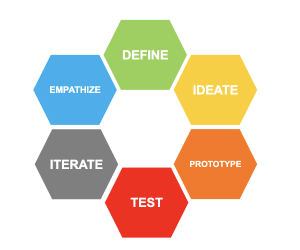 problem-solving step-by-step, by first conducting empathy-led interviews to identify peers’ preferred learning environments. Jacob, a student with Upward Bound, said the peers he interviewed “feel like most schools are made out of mostly concrete, and it feels trapping.” His group went on to design a school centered around nature, music, and creative freedom.
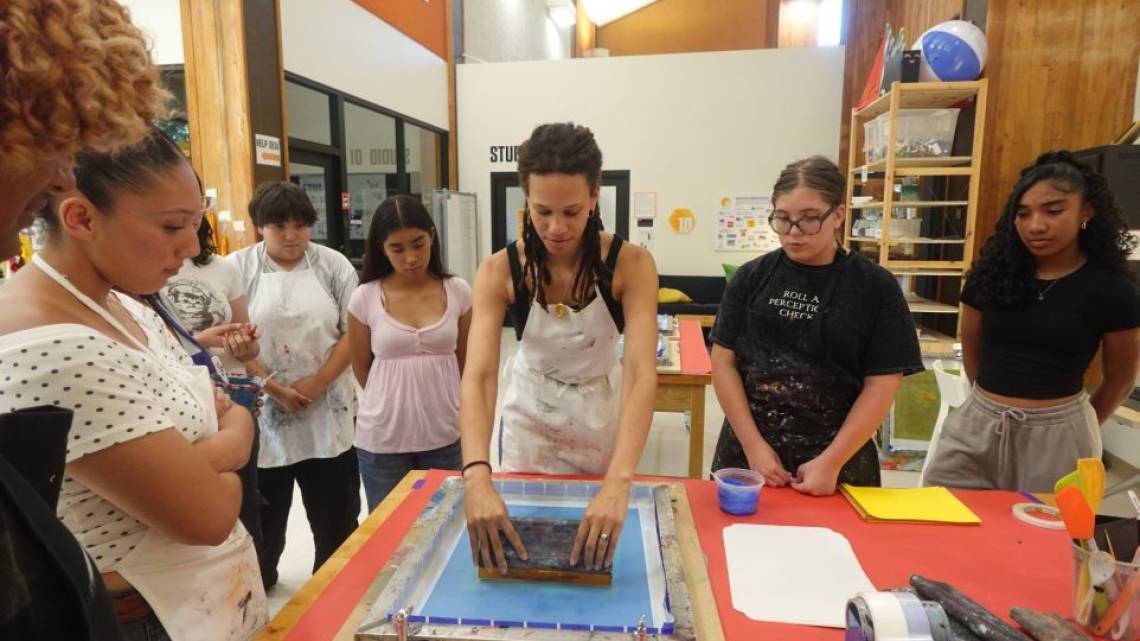
Across all the groups, the through-line was the same: listen first, then prototype. Biancca, a student with PAYS, felt that “listening to students’ ideas about what they want in their schools and getting the chance to incorporate them” was the most important part of this design project. Her group built 3D school models from recycled materials, recorded prototypes of morning announcements in the Soundbox, and screenprinted original mascots.

When the future proves uncertain and unstable for young people around the world, design thinking becomes a way of seeing the world differently. Linett explained that “exercising your imagination is like a superpower. It’s such a source of hope and dreaming up new possibilities. These students are in their last two years of high school, so it’s important to start building up their confidence in imagination. It’s critical; systems of oppression work very hard to convince you that this is the way the world is supposed to be.” At the Hive, we’re committed to cultivating a space where students can imagine and bring transformative ideas to life.
written by Reese Rosebeck
Hours
Mon – Thurs | 9am – 10pm
Fri | 9am – 7pm
Weekends | 1-5pm
