
Elizabeth Ortega – Green Jobs Board
Designing for Green Careers: My Summer with Green Jobs Board
By Elizabeth Ortega (she/her), Pomona College ’27
 Like many curious creatives on campus, I naturally found myself at the Hive, the Claremont Colleges’ creativity and collaboration hub. At first, it was an intriguing and conveniently located study space between my classes in Lincoln and Edmunds. Before long, it became a creative home base where I explored ideas, built prototypes, and collaborated across disciplines. Before diving into what I did this summer, I want to provide some background information about myself… My name is Elizabeth Ortega, and I am a junior at Pomona College majoring in Cognitive Science and Media Studies.
I was introduced to Human-Centered Design (HCD) through the Hive’s Intro to Human-Centered Design course, and it fundamentally reshaped how I thought about impact. I have always been driven by a desire to help others. During high school alone, I completed over 1,600 hours of community service across a wide range of causes. But even with that experience, I often found myself asking how I could further contribute meaningfully in spaces where problems felt overwhelming or deeply entrenched. I knew I wanted to make a difference, but I did not yet have a clear direction or means of doing so.
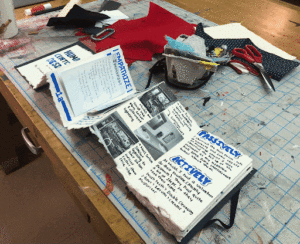
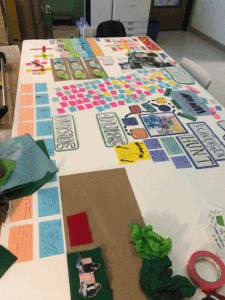
My HCD course not only gave me tools; it shaped my mindset. It taught me that I didn’t need to have all the answers from the start. Instead, I could enter unfamiliar spaces with empathy, ask better questions, and design solutions with communities rather than for them. It showed me that impact is not about fixing things alone. It is about co-creating change, staying open to iteration, and committing to thoughtful, intentional design. HCD became the framework I did not know I needed, turning a general passion for service into a creative, strategic way of engaging with the world.
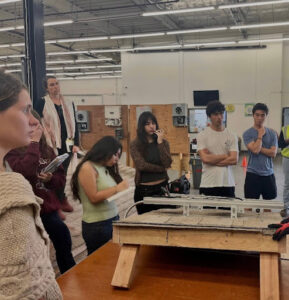 After that course, I wanted to go deeper. I enrolled in Design for Environmental Behavior Change, a class taught by Professor Shannon Randolph, which focused on the intersections of environmental psychology, community design, and public systems. The class brought us out into the field, literally. We visited neighborhoods in the city of Pomona, spoke with residents, and examined how environmental barriers and systemic inequities shape people’s everyday experiences, perspectives, and job-seeking process. For me, it was a turning point. I saw reflections of my community back in Oklahoma in the challenges we explored, and that personal connection deepened my commitment to designing with empathy, equity, and intention.
During that course, we had a guest speaker, Kristy Drutman, co-founder of Green Jobs Board (GJB), whose mission to expand access and equity in the green workforce stuck with me. I did not initially think of myself as someone “in” the green industry, but I resonated with her commitment to inclusion and innovation. After follow-up conversations with both Kristy and Professor Shannon, I found myself applying for a summer internship with GJB. Thanks to the Hive’s Internship Grantee Program, I was able to accept.
This summer, I interned at Green Jobs Board, where I supported the creation of career resources designed to make green industries more approachable for people new to the field and for those navigating the process in general. While there are limitations on what I can share due to privacy, I can say that I worked on creating career guides and a quiz that demystifies entry points into sectors like solar, sustainable fashion, and conservation.
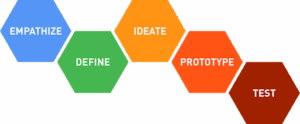
The work felt like a direct extension of everything I had learned in my classes. I followed the design thinking process from start to finish:
- Empathizing with users who might not even know where to start in the green workforce
- Defining the barriers they face, such as confusing job titles, unclear educational paths, or the myth that sustainability careers are only for scientists or engineers
- Ideating new resources that could meet those needs while including fun, engaging ways to discover green career paths
- Prototyping and testing guides, visual posters, and a career quiz that help users find where they might belong in a rapidly changing industry
I collaborated closely with both Kristy Drutman and Usman Fahimullah, the co-founders of GJB, and felt fully supported in my creative decisions. I was given room to pitch ideas, explore formats, and revise based on feedback. That kind of trust and flexibility is not always found in internships, and it made me more confident in both my design skills and my voice as a contributor.
One of my proudest contributions was a series of industry blueprints that served as accessible guides to introduce people to fields like sustainable agriculture and green law. I researched the types of roles, pathways, and skill sets needed, and translated that into content that was both digestible and visually engaging. I then adapted those guides into posters, which meant experimenting with layout, hierarchy, and accessibility, design challenges I genuinely loved tackling.
The project began with a core question: who are we designing for, and what do they need? Job boards can be overwhelming and impersonal. Resource hubs are often noisy, filled with tips and advice that do not always consider the barriers real people face. So instead of pushing out more content, we built something that listened first. We called it Treehouse Guides.
I synthesized insights from secondary research, including transcripts from interviews from my past work with job seekers. I combined that with industry reports and an audit of other job platforms. Three major pain points stood out: first, job seekers with nontraditional backgrounds struggle to find tools that speak to them; second, platforms are hard to navigate and require a high level of digital fluency; third, many users do not realize they already have transferable skills, which leads to confusion or avoidance.
With that in mind, I led a series of collaborative strategy sessions with the founders. We mapped out the user journey through green career exploration, brainstormed modular content systems, and identified a key missing tool: accessible sector guides that could meet users where they are. We asked: What kind of information do job seekers want? How do we support both beginners and those already exploring? How can we create content that is not only informative but also affirming?
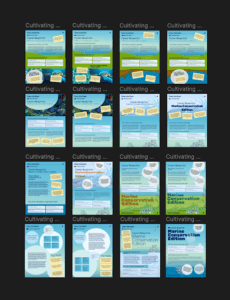 We landed on a content structure: Treehouse Guides (longform, in-depth explainers) and Career Blueprints (shorter overviews for fast browsing). I wrote and structured ten complete Treehouse Guides, each one including the types of jobs available in that sector, what the path could look like without a degree, examples of transferable skills, salary ranges, and curated learning resources. I revised the guides closely with Kristy to make sure they were clear and empowering.
Then came the visual design. I collaborated with Usmanin on Figma to design modular layouts that catered to time-limited users while also enabling the posters to stand out. I created the layout and illustration styles for each guide to match the tone of the sector, making sure each one felt like the essence of the industry, not an instruction manual.
While creating the guides, I realized we still needed a valid starting point. So I proposed and built a Green Career Quiz: an exploratory quiz that uses value-based questions to match users with a sector that aligns with their interests and needs. I developed the complete quiz framework, including 23 sector options, wrote the question bank and logic mapping, created personas for each result, and built the whole experience using Tally. Check out the quiz here: https://tally.so/r/m6EOZo
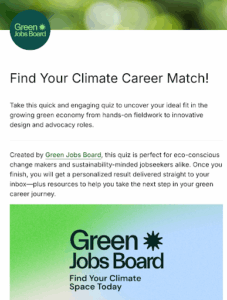 By the end of the internship, I had designed a multi-tool system that included the ten Treehouse Guides, career blueprint posters, a design strategy for the site, and a quiz that connects users to relevant resources with clarity and care.
The work was fast-paced and often ambiguous, but it taught me that strategy starts with listening. That equity lives in the details. And that empathy, even without interviews, is a design tool. Even the smallest decision, such as using accessible language or a simplified, yet carefully designed, layout, can open doors for someone.
What I gained from this internship extended far beyond hard skills. I learned how much thought, care, and strategy go into building something mission-driven from the ground up. I saw what it looks like to run a small, impact-focused team. I saw how design can be used not just to solve problems, but to shift narratives, such as in this case, helping people realize they do belong in the green economy.
Most importantly, this opportunity gave me the chance to work at the intersection of equity, sustainability, and design – a space I never would have found without the Hive. It was more than an internship. It was a chance to apply what I have learned, stretch what I thought I could do, and build something that could genuinely help others.
Human-centered design has the potential to transform how we approach problems, and this summer showed me just how real that potential is.
Feel free to reach out to me at emom2023@mymail.pomona.edu if you have any questions or just want to chat!
Current Hours
Mon – Thurs | 9am – 9pm
Friday | 9am – 7pm
Weekends | 1pm – 5pm
