
10 Years of: Hive Space Design

.
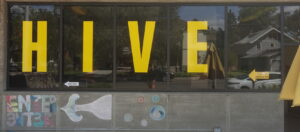
If you ever needed to find me at Pomona, chances were I was at The Hive. It became more than a creative space; it was my home base throughout college for dreaming, building, and connecting.
Amanda Eric (PO ’25)
This month, we’re dedicating our 10 Years of the Hive feature to the very building all of that activity owes itself to: the physical space that makes everything we do possible. Through intentional, inventive, HCD-fueled creativity and elbow grease, the Hive space has evolved into a virtually unrecognizable entity from what it was a decade ago.
Before we talk about “what” has evolved in our physical space over time, we feel that it’s essential first to discuss the “why.” Why does the Hive space look the way it does, and why do we want it to look that way? Our philosophy of space design at the Hive originated with the book “Make Space,” by Scott Doorley and Scott Witthoft from the Institute of Design at Stanford, which is “an inspiring guidebook filled with ways to alter space to fuel creative work and foster collaboration.”
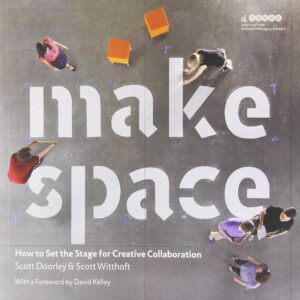
“Make Space” by Scott Doorley and Scott Witthoft
Both Doorley and Witthoft were consulted when the Hive began, and a significant takeaway from their conversation was that space influences culture, and culture, in turn, influences space. With this knowledge, it became our primary goal to create a space that feels welcoming, accessible, and inclusive to all.
 We want it to feel like a place where you can leave your fingerprints, make something, put it on the wall, and have it stay. We are especially keen on a “Yes, you can!” attitude, which you can see exemplified on signage on every wall in every room you find yourself in at the Hive.
Having an interior that looks too pretty to touch or too sterile to relax in would be antithetical to our mission and the vision we have for our work here. Our space is designed to change and inspire students, and in turn, our students inspire change and transformation within it. Much of what we offer at the Hive is directly influenced by student interest, as seen in the Print Lab in 2016. Our Soundbox, as well as the expansion of materials in our other making spaces, such as jewelry, metalsmithing, and leatherworking, were all created in direct response to our students’ voices.
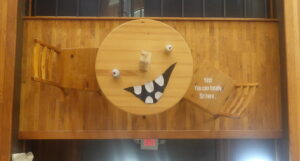
Yes, you can totally sit on our wall-mounted table set!
Another key component of the Hive space is flexibility. The flexibility of our physical space enables us to tailor our offerings to meet student needs and desires. What used to be just a kitchen for our staff was utterly transformed into the Print Lab, and the room has been serving its shared functions ever since. What is now the Soundbox, a music and sound recording studio with top-of-the-line equipment and software for our musicians, podcasters, and DJs on campus, was a closet space belonging to the Studio 1 classroom. The Scrapyard used to house the entire Sewing Shed, previously referred to as “The Shed,” before it was relocated to its own dedicated room in 2021.
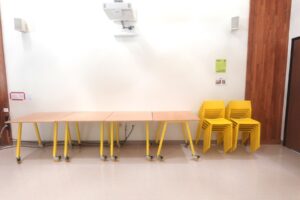
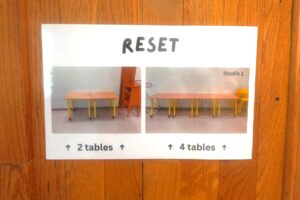
The concept of flexibility is also evident in our classrooms! All of our tables and chairs reside along the sides of the room when not in use, and wheels allow any piece of furniture to be oriented anywhere when class begins. Having flexible classrooms and being able to intentionally set and reset the space to our heart’s content allows the space to feel fresh and alive, maximizing what is being accomplished in any one class. The typical classroom hierarchy, where the professor stands at the podium at the front of the class and the students sit and receive information in their assigned seats, is utterly disrupted and dissolved. This creates more comfort and allows for deeper connections between students as the faces next to them often rotate, and the concept of “ownership” of any one seat is no longer in practice.
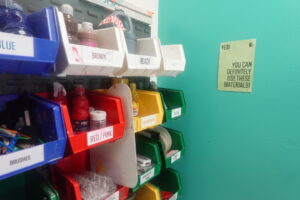
In our making spaces, we also champion flexibility and accessibility. Our materials and tools are available to anybody, free of charge. While we have specific requirements for using the more technically involved or dangerous tools in the space, we have student staff to train students and obtain their certifications, allowing them to use whatever they would like on their own time eventually. We have intentionally created a creative environment that caters to individuals with no experience as well as those with extensive experience.
Now, we can speak to the physical transformations the Hive has undergone in the last 10 years. Seeley G. Mudd was the Pomona Sciences Library, and its walls, hallways, arches, and rooms housed everything that comes with the average library: books, of course, and a quiet space to study and read in. When the building was converted for this purpose and the Hive moved in, there was very little to start with. The changes developed through three major phases:
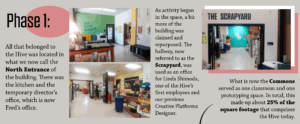
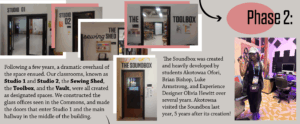
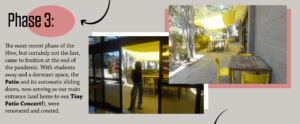
Each year, the Hive space continues to evolve to meet the needs of our staff and students, while also exploring new opportunities to apply the philosophy that has guided the space since its inception. In reality, it is a privilege to have begun from a gutted building that was not precision-designed for our needs, because it allows us to add, subtract, experiment, and invent upon ourselves without limitations, in the way we always have. This summer, the Hive underwent some exciting and significant renovation and reorganization, strongly propelled and catalyzed by our new Assistant Director of Creative Facilities, Trevor Grant. I spoke with Trevor to assess the changes that have been made, marking the start of Phase 4 of the Hive’s ongoing development.
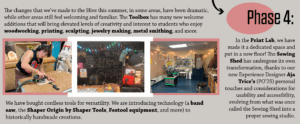
We are thrilled to see that students this year are already impressed by and enjoying the improvements in our Hive. We hope that anyone reading this who hasn’t seen them will take a moment to come by and look around. Thank you to Trevor, Min, Aja, and the rest of our Hive staff for their contributions to these developments over the summer!
by Salina Muñoz
Current Hours
Mon – Thurs | 9am – 9pm
Friday | 9am – 7pm
Weekends | 1pm – 5pm
