
10 Years of: Hive Courses + Faculty

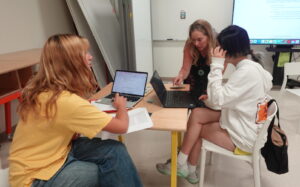
The Hive serves The Claremont Colleges as a collaborative creativity and human-centered design (HCD) education center. The Intro to Human-Centered Design course, offered through Harvey Mudd’s engineering department, was first taught by the Hive teaching team in Spring of 2016 by Vida Mia Garcia and Pat Little (HMC Emeritus professor). Over the last decade, approximately 500 students have explored, prototyped, and tested their ideas through the Intro to HCD class, now taught on a rotating basis by Director Fred Leichter, Associate Director Shannon Randolph, and Senior Associate Director Asha Srikantiah.
In addition to the “in-house” classes we offer, several 5C professors teach their courses in Studio 1 and 2 each semester. Combined with the courses taught by our teaching team, that’s approximately 220 classes offered and almost 4,000 students who have passed through our doors and sat in our classrooms in the last ten years.
We had the opportunity to speak with a few professors teaching here this Fall and gain insight into why they chose the Hive over a typical classroom at their home institution. We asked them to share a bit about their class and what the Hive space means to them, and here’s what we learned:
Faculty Perspectives: Teaching at the Hive
HIST 96: The Amazon + HIST 173: Global Borderlands
taught by CMC’s Sarah Sarzynski
Associate Professor Sarah Sarzynski, an historian and CO faculty advisor for Gender and Sexuality Studies, has been teaching at the Hive for about seven years. In that time, she has witnessed its transformation from a chaotic, flexible space to a well-organized, curricular, and co-curricular hub. This semester, she teaches a course on the Amazon, exploring outsider representations from 19th-century explorers alongside insider perspectives from indigenous communities. The class is mainly discussion-based, with projects that include creating zines using film, photography, and archival materials, as well as developing action or educational campaigns inspired by events such as the COP30 Climate Change Conference.
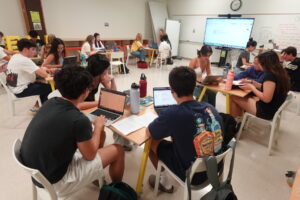 Professor Sarzynski chooses to teach at the Hive because its portable furniture and space design enable dynamic discussions, tangible creative work, and more effective student interaction. “It’s such a difference. It allows students to move around, form community, and feel comfortable talking, things that are much harder to do in a traditional classroom,” she says. The Hive transforms her students’ experience, allowing for deeper connections, hands-on creativity, and creating an engaging, participatory experience. “It’s become hard for me to think of teaching in other spaces because the Hive stimulates my own creativity and enthusiasm for being in the classroom.”
HIST 174: Design Activism
taught by CMC’s Albert Park
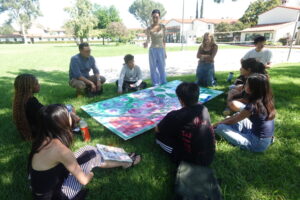
Professor Albert Park, a historian at Claremont McKenna College with a focus on East Asia, has been teaching Design Activism at the Hive since around 2016. His course explores the intersection of design and social activism, both in the United States and globally. While grounded in historical analysis and discussion, the class also features hands-on design exercises, providing students with the opportunity to build, experiment, and physically engage with the concepts they study. “The Hive facilitates creativity for students and faculty that they normally wouldn’t get on their own campus. There’s a sense of breaking boundaries. Literally physical boundaries, but also disciplinary boundaries, and through that breakdown comes new creation,” he says.
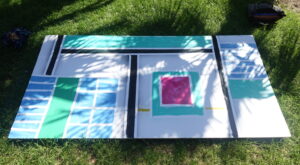
 Professor Park also appreciates the flexible space design of the classrooms and the abundance of making materials. It allows for spontaneity and creativity in ways that wouldn’t happen in a traditional classroom on their own campus. Students can move around and engage in their projects in new ways, making the learning experience more dynamic and innovative. In the photos, the Design Activism students have used foam core board, paint, and tape from the Hive for a class activity related to urban planning and city design.
CORE 3: Living in a World of Numbers
taught by Scripps’ Christina Edholm
Professor Edholm, an applied mathematician from Scripps College, brings the Scripps CORE course Living in a World of Numbers to the Hive, where students explore how data is used across disciplines and learn to communicate their findings effectively.
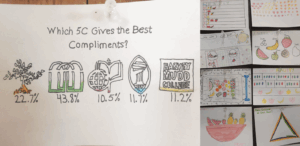
The Hive’s flexible setup is ideal for the hands-on, collaborative format of the class and its small discussions and breakouts. One standout project draws inspiration from the Dear Data Project by Giorgia Lupi and Stefanie Posavec: students collect a week’s worth of data on a topic of their choice and create a postcard visualizing their findings. At the Hive, these postcards are displayed on the wall, letting students interact with and learn from the creative work of their peers, an experience that has brought the classroom to life in ways that Professor Edholm describes as truly special.
Classes Taught by Hive Faculty:
Over time, our curricular offerings have expanded to expose students to a more comprehensive experience of human-centered design applications in the world. The five courses we offer now, taught through HMC Engineering, Pomona EA, and Pitzer EA, include the following:
Intro to Human-Centered Design
taught on a rotating basis by Fred Leichter, Shannon Randolph, and Asha Srikantiah
From day one, students dive into the Human-Centered Design process through fast-paced design sprints and hands-on collaboration. Human-Centered Design is a creative problem-solving approach that centers real people’s needs, moving through the stages of empathizing to gain insight, defining a point of view, ideating solutions, prototyping, and testing.
Over the semester, students undertake three projects that increase in scope and complexity, progressing from a one-week sprint to a six-week partnership with real-world organizations, including the Napier Initiative, Starbucks, local grassroots nonprofits, and other notable entities. The course shifts from “playground” to “stage,” helping students grow their confidence and deepen their skills through a mix of creative exploration and real-world impact.
Advanced Human-Centered Design:
taught by Asha Srikantiah
For students who have completed Introduction to Human-Centered Design and are ready to go deeper, Advanced HCD offers an immersive, real-world practicum experience. Led by Professor Asha Srikantiah, a cohort of students spends 14 weeks collaborating with an external partner to tackle a complex design challenge from start to finish. Students dive into primary and secondary research, gaining a rich understanding of stakeholders and the surrounding ecosystem. They uncover opportunities for new solutions and bring ideas to life through in-market prototyping and testing, applying the complete human-centered design process to real-world contexts.
Past projects have included partnering with Edulis Labs to bring new-age, eco-friendly hair blonding technology to market, collaborating with the Dana-Farber Cancer Institute to enhance the patient experience by addressing information overload, and working with the nonprofit design lab Amplifier to create the Well + Being card deck to facilitate emotional and social connection for students post-pandemic.
Design for Environmental Behavior Change:
taught by Shannon Randolph
Where anthropological methods meet human-centered design, this interdisciplinary course explores how to create meaningful and sustainable change. Led by Professor Shannon Randolph, students combine design thinking with environmental practices to address real-world challenges that require shifts in human behavior.
Working in small teams with local project partners such as GRID Alternatives, OpenFung, and LA Metro, students tackle a semester-long environmental design challenge, applying behavior change research, creativity, and collaboration to craft impactful solutions. In the past, students have created design solutions to educate and inspire Claremont residents to adopt drought-resistant landscapes. In another project, partnered with the LA-based GRID Alternatives, students conducted research to expand access to renewable energy and workforce development in underserved communities.
Community Engaged Planning + Design for a More Just Public Realm
taught by Chelina Odbert
Taught by the CEO and Founding Principal of Kounkuey Design Initiative, Chelina Odbert, this course aims to establish the tenets of urban planning that focus squarely on justice and create equity in the built environment. It introduces core concepts of community engagement, participatory planning, and landscape design, helping students situate themselves as technical and political aides for resident change efforts. The discipline of urban planning has a profound impact on the lives of people across the city, encompassing social, economic, environmental, and health-related aspects. All too often, though, this impact has been delivered unequally, along the familiar lines of race, class, and gender.
In the course, students examine urban public spaces in Los Angeles through the lenses of homelessness, gender equity, and racial justice. They employ a participatory planning approach to reimagine these spaces, designing them with the voices of diverse communities that have been historically overlooked during design and planning processes. Students engage in action-based research, community engagement, and mapping, using design and programming strategies to create proposals that better serve those communities that need access to public spaces most.
Design + Equity:
taught by Asha Srikantiah and Kareem Collie
The Design and Equity seminar is a course offered by Harvey Mudd College at the Hive, typically taught by Professor Asha Srikantiah. The seminar format brings together students who are passionate about exploring the intersection of design and social equity. Inspired by both student interest and our faculty’s commitment to rethinking design education, the course serves as a full-credit option open to students across the 7Cs. With a curriculum built around collaborative exploration, students engage with diverse media, including readings, audio content, news articles, and social media, fostering conversations that reflect, challenge, and expand their understanding of design.
The class emphasizes learning through reading, discussion, and hands-on making, with students designing and executing three creative projects throughout the semester. This approach encourages students to think critically about the implications of design choices, embracing the academic space to practice conscientious, context-aware design.
This semester, Kareem Collie leads the Design + Equity seminar. Kareem has previously worked at the Hive, assisting with its launch, and has returned to teach here after working for design companies such as IBM, Nickelodeon, Coca-Cola, and others.
Hours
Mon – Friday | 9am – 6pm
Weekends | Closed
