
10 Years of: Partnerships


Empathy, creativity, and action are three fundamental tenets of the Hive’s mission. Empathy, to deeply engage with and understand the needs of users. Creativity, to generate ideas, iterate, and prototype solutions. Action, to implement those solutions and adapt them to real-time, real-world situations. Last month, we covered all the curricular offerings students can explore at the Hive, and in this segment, we delve into how our classes go the extra mile through external partnerships.
In Hive design classes, students are introduced to a real-world design challenge framed by a partner company, organization, or nonprofit. Students work collaboratively in teams, typically with one rep from each college, to solve the challenge and present their work to the partners. From there, their work not only contributes to their personal learning journeys but also to something greater than themselves: solutions and ideas adopted and applied in the real world. It is imperative to us that our classes create dynamic, tangible experiences with real-world partners for students to flex their design muscles. This semester, Intro to Human-Centered Design, taught by Fred Leichter, is partnered with the League of Women Voters to find ways to increase civic engagement among individuals in the community. Design for Environmental Behavior Change, taught by Shannon Randolph, is partnered with OpenFung to bridge information gaps between scientists and the public working with regenerative mushroom-based materials and increase adoption of building with these materials using design tools. Let’s look at some of the other collaborations we’ve had over the last decade below.
Our partners have included government agencies, public services, local and international NGOs, startups, and established companies. The design challenges students face span a breadth of areas, ranging from public radio, public health, park design, shared biking systems, drought-tolerant landscaping, social-emotional wellness education, regenerative energy jobs, new science technology, and more. We’ve worked with Amplifier, a nonprofit design lab, and SYPartners, a consultancy transforming leadership in organizations, to target issues of representation and spread word from marginalized voices. We’ve worked with Edulis and Mimente, science and mental health startups respectively, to communicate to and grow clientele, and develop go-to-market strategies. We do partnerships-based classes because it provides students with real world experience they can put on their resume, a safe space to experienment, fail, and learn, and an opportunity to contribute innovative impact to the communities around the LA region. Students have shared that our design in action classes and summer internship program helps them both directly or indirectly with their career trajectories. Here are some partnership and alumni experiences we’d like to highlight, with the complete list of partners at the bottom of the article.
Edulis Labs, Advanced HCD, Spring 2025.
Edulis labs is a new material science company reinventing hair color, founded by Pomona alum Nina Warner (’17). Advanced Human-Centered Design students worked to assist with introducing a new product to market. The product, NovaBlonde, is a professional-grade hair pigment lightener designed to cause 95% less damage than traditional bleach, and Edulis’s first major launch.
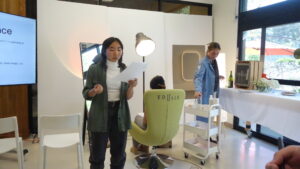 Students worked in small teams throughout the semester to bring a human-centered lens to the Edulis go-to-market strategy. Each team took a different approach to designing the launch of the Edulis brand, ranging from in-salon customer experiences to creating educational models for professional colorists. They created launch marketing strategies, identified key early adopters, and developed implementation strategies. Over ten weeks, students brainstormed, prototyped, tested, and pitched ideas directly to the Edulis team.
From Nina herself: “Partnering with the Hive surprised me in every way possible— the students combined untempered creativity with deep research to uncover new paths to market for Edulis. We were so impressed with their work, we ended up hiring one as a summer intern and another as a full-time employee. It is an understatement to say that Hive simply had an impact on Edulis. It has shaped Edulis’s foundational strategy and culture in profound ways that we expect to carry into the company’s future.”
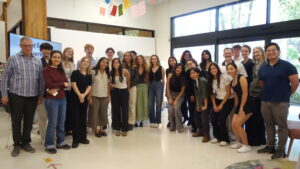
One student, Viddushi Hingad, was able to continue working with Edulis after her experience with the class. This is what she had to say:
“My experience in the Advanced HCD class at The Hive was a pivotal point that launched my career at Edulis. The program was designed as a direct partnership, allowing us to tackle real-world business challenges from day one. I am beyond grateful for the experiential learning the class and the Hive provided me with.
This setup was invaluable, serving as a semester-long, practical “interview” where I could demonstrate my skills in a way a resume never could. The Edulis team witnessed my process firsthand, observing me initiate and lead our team’s survey design and analysis, which grounded every recommendation in data. They also saw my team and I prototyping at The Hive, developing the “Experience Booth” that became a key part of our go-to-market strategy. It became clear that my focus on research methods and data-driven insights aligned precisely with their requirements.
Beyond specific skills, the class instilled in me the understanding that everything is iterative. It demonstrated that design thinking is an effective framework for problem-solving, applicable not only to products but also to strategies and team dynamics. We learned to continuously test, listen, and refine. This critical lesson has guided me at Edulis, where, even in my current role, I constantly engage in these cycles. It fosters an “always get better” spirit, treating every milestone as a new opportunity to iterate and improve.
The class shifted my perspective, confirming my desire for work that is both useful and meaningful. It provided the clarity that Edulis was the place I could do that.”
GRID Alternatives, Design for Environmental Behavior Change, Spring 2025.
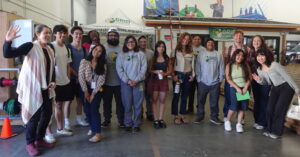
Design for Environmental Behavior Change partnered with GRID Alternatives, a nonprofit organization dedicated to expanding access to renewable energy and workforce development in underserved communities. GRID Alternatives operates with two key pillars: providing no-cost solar installations for low-income households and offering hands-on job training programs to help individuals from these communities enter the renewable energy workforce.
Over eight-weeks, students embraced the challenge: How can renewable energy workforce development programs be made more accessible, affordable, and anti-racist? The class took a field trip to GRID Alternatives’ Los Angeles location and had the opportunity to engage with GRID employees and trainees to learn more about their mission and day-to-day work. Students conducted interviews and research in small teams to explore the problem space, and created deliverables in the form of recommendations and design concepts that GRID would integrate into its workforce development strategy. The project helped them refine their approach and improve the program’s impact, further enabling and enriching the success of their trainees.
Amplifier, Advanced Human-Centered Design, Spring 2024
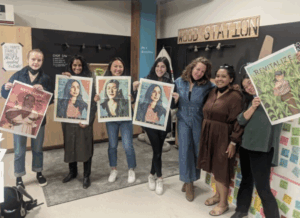
Amplifier is a nonprofit design lab, one of whose key initiatives is Education Amplifier, which “aims to help K-12 teachers facilitate non-partisan conversations about social justice issues in the classroom.” Amplifier was looking to maximize the potential of Education Amplifier and better understand the needs of the teachers they served. They saw teachers in their network struggling with bandwidth and lack of resources, and the pandemic only amplified their challenges.
Amplifier partnered with our Advanced Human-Centered Design class and gave our student team a design challenge they would tackle over the semester: How might we engage K-12 teachers interested in fostering conversations about social justice in the classroom throughout the school year? Students created the Education Amplifier Activity Deck, a deck of cards designed to put power in the hands of the students and alleviate stress on teachers. Amplifier’s team launched the Well + Being card deck, even making it available for purchase on their website!
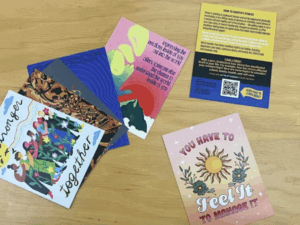
LAist Public Radio, Intro to Human-Centered Design, Fall 2022
LAist is a public radio station providing local and national news, NPR, things to do, food recommendations and guides to Los Angeles, Orange County and the Inland Empire. Students were tasked with designing for discovery, and figuring out why listeners were tuning in.
“They asked our students, how might they meet their listeners more fully in those moments of isolation, confusion, or overwhelm? They needed fresh ideas, energy, and perspective. Ten teams of five students each got to work, each focusing on a different mode of engagement – Connect, Discover, Navigate, and Change. The student teams conducted dozens of interviews, spent hours observing their local communities, immersing themselves deeply in the problem space. One group developed The Neighborhood Box, a monthly subscription “guide box” full of tastes and treasures designed to inspire residents to leave their local haunts behind for a day and discover a new and vibrant neighborhood in the city they love.
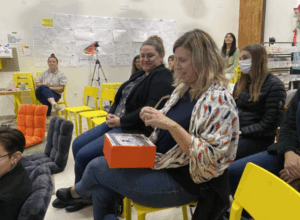
Kristen Muller, Southern California Public Radio’s Chief Content Officer, interacting with the team’s Neighborhood Box prototype
Animals Asia, Summer Fellowship Program, 2018
This was one of the earlier partner projects the Hive took on, featuring three HCD students, Laura Zhang (PO ’19), Lena Tran (PI ’18), and Kim Ha (PI ’18), and Shannon Randolph. This program is now called the Summer Internship Program at the Hive. Their report details the infusion of HCD within the project in a pointed and incisive way, reflecting the values of the Hive then, that we still uphold today. From their report:
“Animals Asia, an animal welfare organization, focuses on shifting consumer demand away from bear bile and ending the inhumane farming of moon bear bile. With support from EnviroLab Asia, the Pomona College Dean’s Office International Initiatives, and the Pomona College Internship funds, in June 2018, our team set off for Hanoi, Vietnam!
Moon bears are captured from the wild and kept in small cages on bear farms is for their bile. Bear farmers extract the bile from the bears’ gallbladders (a painful process). They later sell the bile to people who use bear bile as traditional medicine to treat inflammation and liver and gall bladder conditions. While it is currently illegal to extract bear bile in Vietnam, it is not illegal to keep the bears in captivity in small metal cages. Bears can only be rescued if the bear farmers voluntarily give up the bears or they are caught in the act of bile extraction (which rarely ever happens). We used HCD combined with additional social science methods (surveying and rapid ethnographic qualitative analysis) as our approach to assess this issue and identify points of intervention. Using this quantitative and qualitative data, we drew insights that helped us define (or reframe) personas for our target audiences (also called users) and unexpected insights about user needs around which to frame this behavior change campaign. In the ideation stage, we used structured prompts, such as “How might we … (make herbal alternatives more accessible)?”, to brainstorm as many realistic or unrealistic ideas (100+) as possible. Then, with AA staff input, we selected the ones we thought were most feasible, most exciting, and most groundbreaking human-centered strategies to reduce bear bile demand to prototype. In the prototyping stage, we used very basic materials (post-its, cardboard, colored paper, simulations) to create prototyped experiences of our ideas, and then tested these prototyped experiences with original users to gain their candid feedback. Based on their candid feedback, we could determine whether our idea was something that our users would actually use, or whether the prototype needed more modifications or needed to be scrapped completely.”
Complete List of Hive Partners:
Los Angeles County of Public Health
LA Metro
3 Valleys Municipal Water District
Global Women’s Water Initiative
Dana-Farber Cancer Institute
Brain Tumor Network
Kounkuey Design Initiative
Field Innovation Team
Napier Inttiative
Mimente
Universidad de Monterrey
Gente Organizada
SEED
ReWilder
CHERP Solar Works
SYPartners
Didomi
Active SGV
Open Fung
Oldenborg Center for Modern Languages and International Relations
Pomona College Community Engagement Center
Pomona College Sustainability Office
The Claremont Colleges Services
Summer Hours
Mon – Thurs | 9am – 4:30pm
Friday | 9am – 3pm
Weekends | Closed
