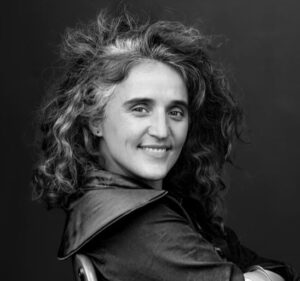
Chelina’s Background
Chelina Odbert grew up in Sacramento and attended Claremont McKenna College (CMC), where she double-majored in Psychology and Spanish. While at CMC, she did clinical work at the Autism Center and was actively involved across campus. After graduating, she spent a year teaching in Honduras and another year in Mexico, experiences that reinforced her commitment to social justice. Speaking to that, she says, “I’m Mexican-American and Serbian-American, and growing up, I always knew, though I wouldn’t have called it social justice at the time, that the work I would do professionally would be about creating easier access to opportunity for communities, for black and brown communities, or communities like mine.” She later pursued a Master’s in Urban Planning at Harvard’s Graduate School of Design, where she focused on how design could be a tool for inclusion, equity, and social justice.
KDI and Chelina’s Work
At Harvard, Chelina met like-minded people who wanted to use design in non-traditional ways and co-founded Kounkuey Design Initiative (KDI), an organization that applies design and urban planning to support under-resourced communities. KDI’s approach is rooted in participatory design, meaning that residents are directly involved in identifying problems and shaping solutions for their neighborhoods. Chelina says, “At the core of KDI is the foundation of a design practice that’s rooted in fostering agency for communities and everyday people to define change initiatives that are priorities to them. We see our professional experience just as needed and valuable as residents’ lived experience, and when the two of them come together, that’s kind of where the magic happens.” KDI has worked internationally, across the U.S., and in greater Southern California, particularly Los Angeles and the Eastern Coachella Valley. Their work includes the development of public spaces, improvement of infrastructure, and advocacy for policy changes that address long-standing community needs, utilizing design to expand access to resources and opportunities.
As a CEO, Chelina sees entrepreneurship and creativity as intertwined ventures, particularly when it comes to impact-driven innovation. She believes successful entrepreneurship requires identifying challenges, understanding barriers, and developing creative solutions to bridge gaps in any problem area. She says, “I think the reality is, in our world today, entrepreneurship for impact is the most important kind of entrepreneurship that we can be focusing on, because we have so many challenges that must be impacted in order for us to continue as a society and as a planet.” |