
Profiles of Impact: Jenny Cang
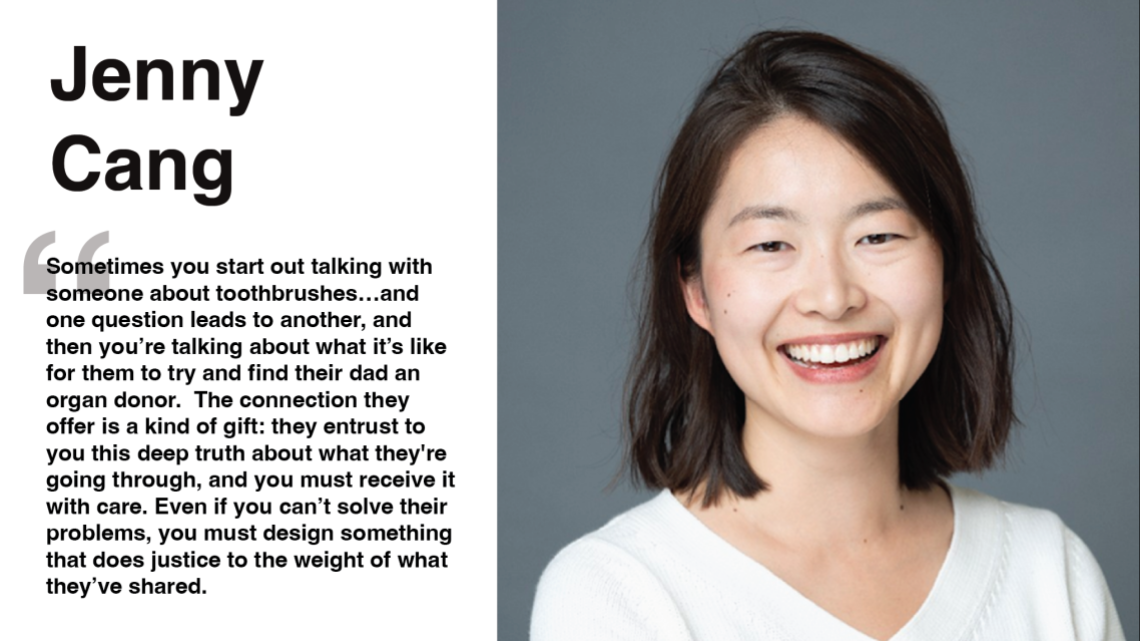

Jenny majored in economics at Claremont-McKenna (2017) before joining Deloitte as a management consultant. After five years focusing on mergers & acquisitions, Jenny earned her MBA at MIT’s Sloan School of Management. She is now an AI Strategist at StackAI, an enterprise solution that enables companies to adopt agentic AI at scale.
I grew up in China, where liberal arts colleges aren’t really a thing. But I read somewhere that CMC was supposed to be the happiest college in America…and I wanted to try living in that kind of weather.
I got here and did the typical CMC thing: I studied economics and got a summer internship in consulting. I’d never heard of the Hive before my senior year, when my friend told me that Human-Centered Design was an easy A. But then the course started and there was a kind of energy I’d never felt in class before. We moved around the furniture to see how it’d change how we learned, and the class projects sent us out into the world. In my econ classes, I’d sit in the back, and maybe ask a question sometimes. But for HCD, I’d always be in the front row, raising my hand at every question.
For the first assignment, Fred asked us to sit in a corner of the campus and see how much we could learn just by observing. I went to this little cafe at Pitzer, and at first it was boring. But I ended up sitting there and watching for two straight hours. We were supposed to fill a page, but—like the good overachiever I am—I filled up a whole notebook. Just by being patient, by really listening, I got this deep glimpse into people’s lives. I’d never done this kind of connecting, and I really wanted to get good at it.
Growing up, I was always a sensitive kid…and it didn’t always serve me well. I was timid. I was afraid to speak up; I’d watch from the edges and take mental notes. And then I got to HCD, and I discovered that this same quietness that I’d struggled with my entire life was actually a superpower. I could observe how people interact with each other and their environment, and I could suss out What does this person want? Human centered design gave me the tools to become who I’m meant to be.
After just a few months in HCD, I knew it was what I wanted to do for the rest of my life. So I asked Fred for advice on how to reject the management consulting offer I’d received so I could find a job at a design firm. But Fred helped me see that HCD is a mindset you can bring anywhere you go, no matter what you do—even if your job title doesn’t say anything about design.
I didn’t guess, though, that M&A at Deloitte was where I’d get to practice empathy. But it turned out that a company getting acquired is an incredible moment to design for. Everybody—from the CEO to the intern—is burning with deep questions: What’s going to happen to me? Am I still going to have a job? Who’ll be my manager? What about my benefits?
I fell in love with the problem of helping people through these transitions: How do you move from reacting to this news, to receiving information, to getting excited by what’s coming? As the designer: how do I give you a feel for how you might belong in this future?
On the surface, most people seem perfectly fine and normal. But if you crack open to the person underneath, they get so interesting. In my new job, I share an office with 20 engineers who are wildly different from me and have no interest in talking. But in my head, I think: I’m going to crack you. I will keep making an effort to learn about you and listen to what you say, and one day I will get to know who you are.
Current Hours
Mon – Thurs | 9am – 9pm
Friday | 9am – 7pm
Weekends | 1pm – 5pm
