
Profiles of Impact: Susan Chang, M.D.
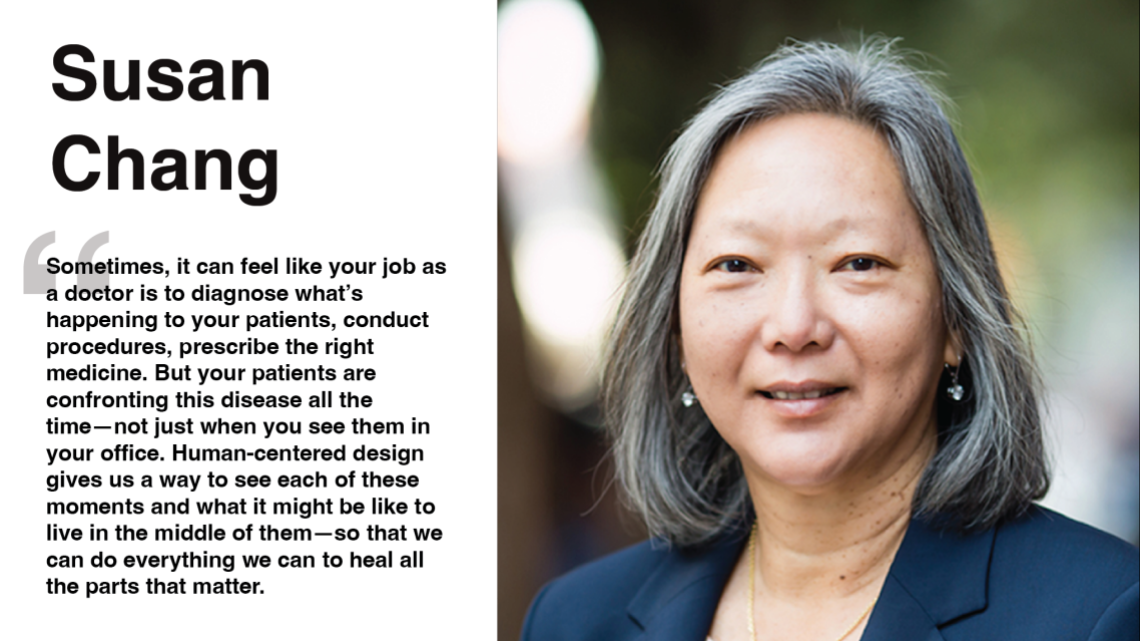
Dr. Susan Chang is Director of Supportive Care Services in the Division of Neuro-oncology at UCSF, and has sponsored several projects involving students from the Hive. For her senior thesis, Anya Zimmerman-Smith (Claremont McKenna, 2021) partnered with Kaitlyn Paulsen (Harvey Mudd, 2022) to scale the impact of The Honor project, a ritual in which members of medical teams gather regularly to commemorate their patients who have passed away. (Dr. Chang distributed the video they created to every neuro-oncology unit in the country.) Paulsen also worked with Dr. Chang to deepen the impact of the Milton Marks Family Camp, as described below.
In my job, you need to get used to your patients dying—because it happens a lot.
And I thought I’d become pretty good at helping my patients through this journey. Until the wife of one of my patients told me, very directly, that we had not done a good job taking care of her. We had not fully acknowledged what she’d been struggling with.
Her husband had been my patient; he was the one in treatment. But she’d been the one sitting by herself while he was in the MRI. Driving him home afterwards. Dealing with all the ways he changed in between visits. With brain tumors, your father or your husband is working, and making dinner for the kids, and functioning normally—and then suddenly none of that is true anymore. If we’re only treating the tumor, we’re not doing enough.
That conversation sparked the Gordon Murray Caregiver program at UCSF. Our logic was simple: support the caregiver and maybe the patient won’t need to go to the emergency room, won’t need to be hospitalized. Good care has to be bigger than the patient alone. It has to include the child trying to understand why their mom isn’t the same as she used to be. And the healthcare providers who carry loss after loss and keep coming back. We needed to help each of these people feel less alone in each of those moments.
The caregiver program supports the Milton Marks Family Camp, a space for families where one parent has a brain tumor. We were proud of our work at the Camp, but we were still missing things. When Kaitlyn Paulsen (Harvey Mudd, 2022) came to observe the camp as part of her HCD thesis project, she helped us see them. We’d created all these wonderful resources for the patients, and all these supports for caregivers…but we hadn’t looked hard enough at what this experience was like for the children tangled in it all. They, too, had questions—and no good way to get answers.
Kaitlyn helped us make space for children to talk to their parents’ doctors directly. And honestly, the idea scared me. I give talks all the time, all over the world, in front of all kinds of people. But I was so nervous in front of the kids. Because they will ask the exact thing adults are too afraid to say.
One child asked me my favorite color. Another asked for my favorite song. Then a boy asked me what it feels like to tell a patient that there is nothing more you can do to help them. Another asked why his mother had been fine before surgery…and couldn’t walk afterward. I explained to him about strokes, and how blood vessels work, and he said, “Oh, okay,” and ran off to play. He just wanted the truth.
In neuro-oncology, loss is constant. Every month, there are patients we have known, often for a long time, who are just gone. But even moments like these can start to feel routine when you do them all the time. Then somebody comes in and asks Why are you doing things this way? And it makes you stop what you’re doing, and suddenly see it again.
Current Hours
Mon – Thurs | 9am – 9pm
Friday | 9am – 7pm
Weekends | 1pm – 5pm
