
Design Thinking at the Accelathon: Claremont Accelerator Recap
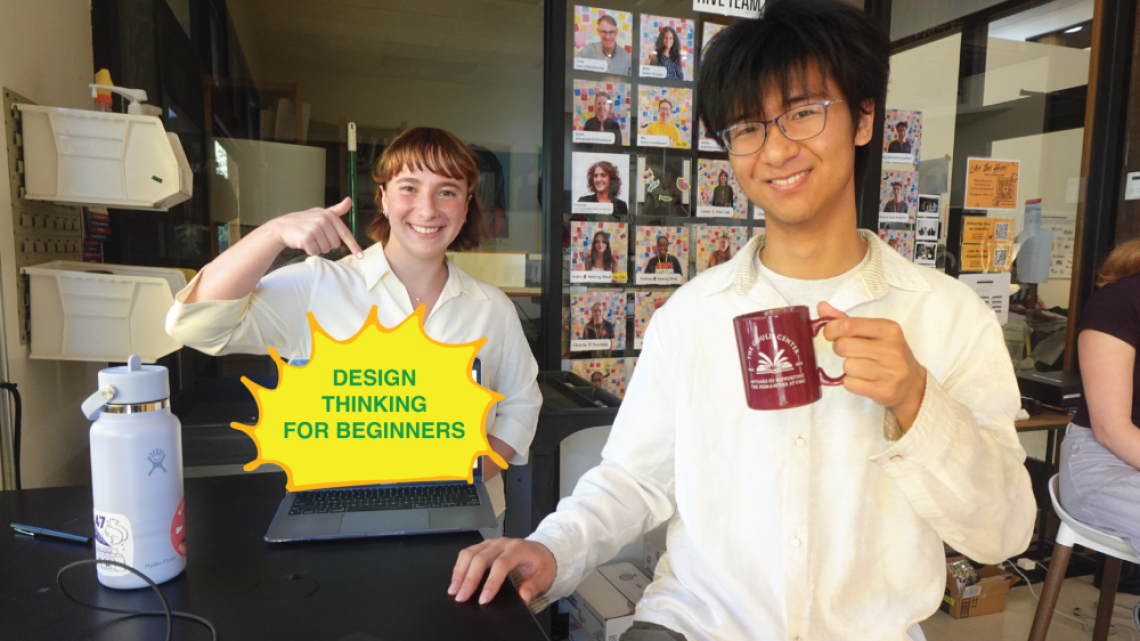

Claremont Accelerator hosted its first Accelathon at the Hive, a fast-paced hackathon challenging participants to “fix a broken system or institution.” With just five hours to ideate and prototype, teams used AI tools like Claude to build a product with power to solve real-world problems. Amid the chaos, two students invoked Human-Centered Design (HCD) principles to highlight one of the most important points in this context: remember who you’re building for.
Charlotte Friedman, a junior at Pomona majoring in cognitive science with a concentration in HCD, and Weitao Ke, a first-year student at CMC studying computer science and HCD, led a design thinking crash course for competitors eager to claim the first-place prize.
Weitao
“We’re aiming to help them navigate the HCD process so they can have a better way of generating ideas and figuring out just which one they should pursue.”
In a crunch for time, their workshop introduced a condensed version of the process (empathize, define, ideate, prototype, iterate) that could still be applied to the single-day sprint.
Charlotte
“What we’re hoping to do is remind all the builders here to focus more on the user that they’re trying to solve for,” she said. “To ‘fall in love with the problem,’ so they can center in on the people they’re trying to help, rather than just jumping straight to coding something that looks super awesome.”
In a space where polished prototypes and technical sophistication often garner praise and success, HCD keeps participants mindful of resisting the instinct to optimize too early for appearance or performance. It pushes them to define the problem more clearly, grounded in real human needs.
Weitao reminded us that while design is often by humans, for humans, it isn’t always exactly human-centered.
“You could have profit-centered design, where you disregard ethics or social impact. Or design for pure artistic purposes, or just for your portfolio,” he said. “We’re trying to avoid that. We want to push people to build something that actually addresses the needs of those you’re claiming to serve.”
These conscious choices fit within the greater context of AI’s rapid development in today’s world. While these tools accelerate what students can build, the question of what should be built, and for whom, becomes more urgent.
written by Salina Muñoz
Hours
Mon – Thurs | 9am – 10pm
Fri | 9am – 7pm
Weekends | 1-5pm
