
Profiles In Impact: Brian Bishop
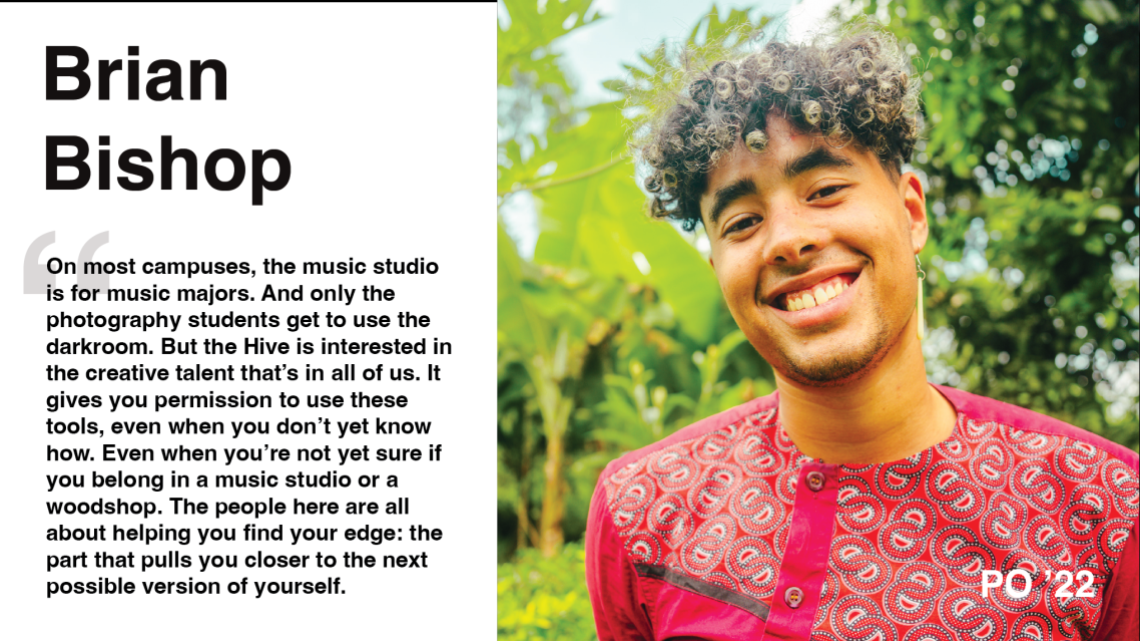

A double major in Media Studies and Mathematics (Pomona, 2022), Brian co-founded Didomi, a social enterprise addressing the water crisis, while in school. He then spent a year as a management consultant at The Boston Consulting Group before enrolling in graduate studies at the Interactive Telecommunications Program (aka, The Center for the Recently Possible) within NYU’s Tisch School of the Arts.
I chose Pomona because of the Hive.
I got into a bunch of good schools—Princeton, Brown, Macalester—and they all had the usual good-school things. Then I walked into the Hive and thought: Wait, am I still at a college? There were workshops, people hanging around, stuff getting made. It felt closer to the real world. Not in some corporate way—but more like: We’re here to work together and make cool things.
One thing I did with the Hive was grow Didomi. We sell reusable stainless-steel water bottles to universities, sports teams, corporations—and use part of our profits to fund water projects in Africa. We didn’t want people to give back because they felt guilty: we wanted them to picture a world where there is no water crisis. We worked with Kareem to build our visual narrative, and with Shannon’s class to develop an immersive experience called The Oasis that got students excited about combatting the water crisis.
The other big thing was rebuilding the Sound Box, one of the making spaces at the Hive. I was a student worker at the Hive, and I said: “There’s this space, and I haven’t seen much happening there. Could I take that on?” On a more typical campus, somebody would’ve told me to slow down. But at the Hive, the message was: Go for it. I raised money, bought equipment, and brought in some on- & off-campus musicians to lead workshops. Students now had a space to collaborate on music, and they started putting together performances. The idea needed room to grow, and that’s what the Hive provides.
On most campuses, the music studio is for music majors. And only the photography students get to use the darkroom. But the Hive is interested in the creative talent that’s in all of us. It gives you permission to use these tools, even when you don’t yet know how. Even when you’re not yet sure if you belong in a music studio or a woodshop. The people here are all about helping you find your edge: the part that pulls you closer to the next possible version of yourself.
I did two theses while I was at Pomona: one for media and one for math—but both of them were transdisciplinary. One used mathematics to inform creative decisions. The other was all about the idea of “total artwork,” which basically means: don’t restrict yourself to one medium or another; instead use as many as you deem necessary to create the vision in your mind. The Hive gave me the space and funding I needed to build out both—the chance to iterate, practice, and perform my ideas.
I spent a year after college at The Boston Consulting Group, before going back for graduate studies in Interactive Art and Technology at NYU. The Center for the Recently Possible feels like the Hive—if the Hive were in Brooklyn. My work is all about traveling across technological and narrative boundaries: I’ve been experimenting with breath capture and coding music; as well as producing events that center emerging Black new media artists.
I grew up between African, American, and Hispanic cultures—and my interests are a mix too: media, math, music, social impact, entrepreneurship, technology. The Hive pulls in people who combine various kinds of expertise within themselves—and it gets them mixing together. The middle of that mixing is where innovation happens.
written by Dan Coleman
published by Salina Muñoz
Hours
Mon – Thurs | 9am – 10pm
Fri | 9am – 7pm
Weekends | 1-5pm
