
Profiles In Impact: Dr. Gounder, Dr. Chiou, + LAC DPH
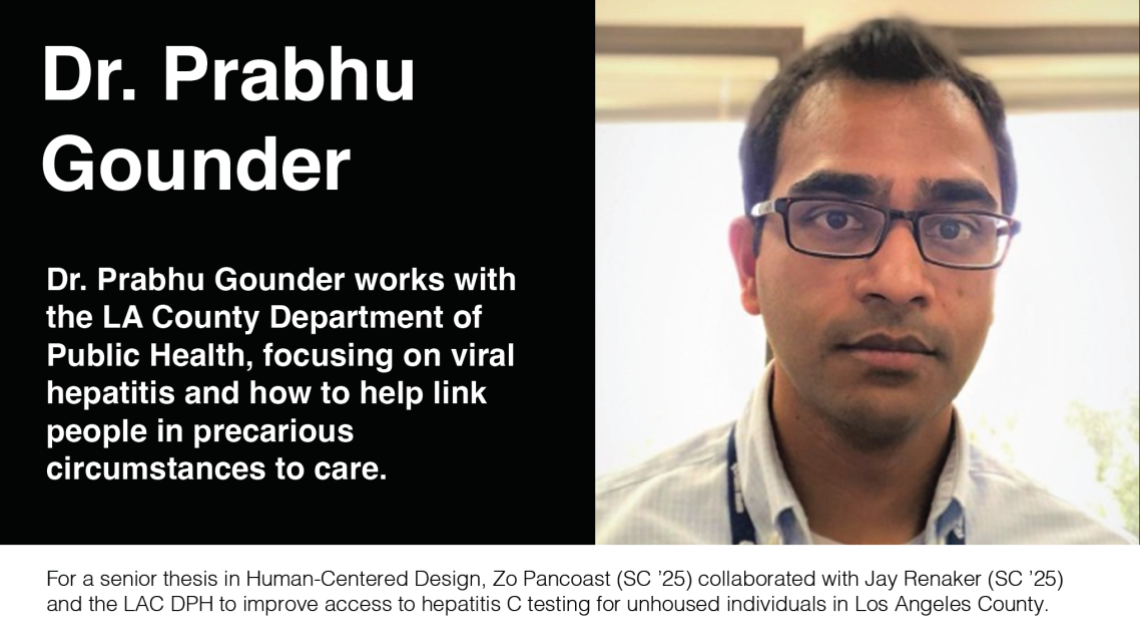


Dr. Prabhu Gounder works with the LA County Department of Public Health, focusing on viral hepatitis and how to help link people in precarious circumstances to care.
Before joining the Oregon Health Authority as Medical Director of Communicable Disease and Immunizations, Dr. Howard Chiou was Senior Advisor for Applied Social Sciences at the LA Department of Public Health.
(Note: The thoughts expressed below are Prabhu and Howard’s alone, and do not necessarily represent the views of any government agency.)
Prabhu
We had a real public-health problem. Hepatitis C is a chronic infection, and even though we’ve developed more effective treatments, we haven’t figured out how to get those treatments to the people who are at highest risk—and disconnected from the health system. For example: people who are coming from jail, are unhoused, who use injection drugs. We had to identify people with hep C in those settings, and actually connect them to care.
We’d tried a number of solutions that seemed reasonable: Give people more education. Make it easier for them to make appointments. Better transportation. Incentives. But though these ideas made sense to us, we had no idea if they’d work for the people we needed to reach. We had no feel for what mattered to them or would motivate them. I’ve never been incarcerated. Or lived on the street. Or had hepatitis C while dealing with addiction. We were making assumptions from the outside.
Howard
That’s where I saw how human-centered design could help. HCD helps us understand other people’s lived experience—so that the solutions we build will actually work for the people they need to help.
In clinical medicine, you often rely on protocols. Someone comes in with chest pain, and there’s a fairly standard sequence of steps you take to treat them. But public health problems are never just technical. They’re human, institutional, emotional, and logistical all at once. If you’re bringing only one kind of evidence to the table—the epidemiology, the treatment guidelines, the top-down data—you’re missing something crucial. Human-centered design brings in a whole other kind of evidence: what the experience actually feels like for the people inside it.
Prabhu
We brought in two students from the Hive* to help us understand why people testing positive for hep C were not seeking care. But their investigation helped us see that we were focusing on the wrong problem. The real problem was: why do so many people not get tested in the first place? So we shifted our observation site to a place for people with histories of homelessness. We asked ourselves: how might we increase screening for people who have the basics in place—housing, food, healthcare access?
Howard
The students conducted observations. Interviewed the stakeholders involved. Mapped out their journeys through the whole process of getting screened. And every time Jay and Zo came back to us with their findings, their questions got sharper. Because they were not just collecting impressions; they were learning how to see.
One thing we discovered was that we could screen people at a different moment in the process. Not some grand, magical solution. Something better: a small, concrete shift that came from paying close attention to what the system had missed.
Prabhu
What I keep coming back to is the students’ honest, wide-open curiosity. They were entering situations that were likely far from what they’re used to. Talking to people in positions of authority—and people who spend much of their lives on the streets.
As I saw the intense attention the students were paying, I started to see how narrow my own perspective had become. I’d grown so used to thinking as a physician—focusing on the individual in front of me: their motivation, their choices, the ways they followed through or didn’t. But in public health, we need to focus on the environment that surrounds the individual. It’s less about what they choose to do or not to do—and more about how we can change the larger context to make healthier choices easier to make.
Howard
Design is a bridge. On one side you have the universe of things we know. Our scientific knowledge—the biology, the disease patterns, the evidence base. On the either side are the things we don’t know: what it’s like to be someone else, living in their specific reality. Public health needs both.
I love that the Hive chooses to work in the public sector. Much of design education gravitates toward cleaner, more commercial problems with sharper edges. Because public-sector problems are messy. They’re underfunded. They’re politically fraught. They don’t deliver the same metrics or financial returns. But they matter enormously. And public institutions like ours often don’t have the time, capacity, or design expertise to explore these questions on their own.
This is not the story of students coming in to “solve” hepatitis C linkage-to-care in one semester. It’s a story about the students helping us slow down. They pulled us closer to reality, so we could test out our assumptions. That kind of disciplined curiosity is not a luxury. It’s part of how progress happens.
*Zoe Pancoast and Jay Renaker, who were working on a joint senior thesis in Human-Centered Design.
written by Dan Coleman
published by Salina Muñoz
Hours
Mon – Thurs | 9am – 10pm
Fri | 9am – 7pm
Weekends | 1-5pm
