
Profiles In Impact: Serena Lin
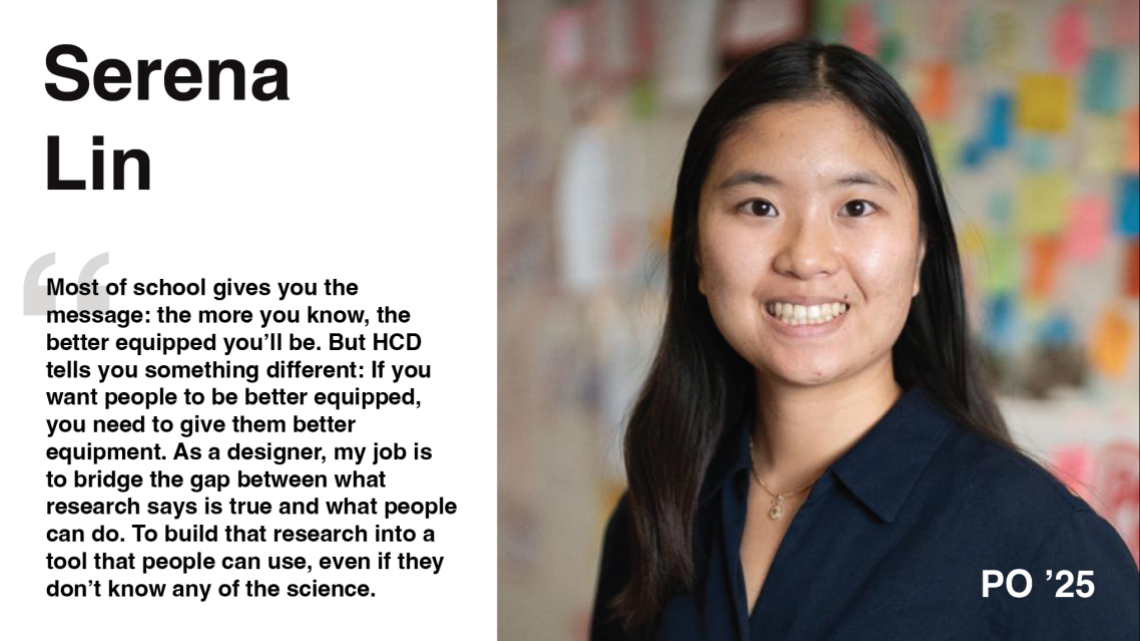
A double major in neuroscience and HCD, Serena launched UpliftNotes during her time at Pomona. Designed to spark meaningful conversations across generations, the toolkit helps people of all ages connect with older adults in their lives: family members, neighbors and others—including those experiencing Alzheimer’s or other forms of cognitive decline. She is now a consultant in the customer strategy division at Deloitte.
I’ve been volunteering in memory care units since high school, and the training I always get is, basically: This is how you push a wheelchair, and If somebody says something weird, just go with it. That’s it. Or maybe they tell you to watch a 3-hour training video…as though that’ll somehow be useful to a 19-year-old trying to connect with someone who’s 93 and has dementia and doesn’t know who you are.
When I started exploring, I saw how many people, like me, have a parent or a grandparent whose memory is slipping—and don’t know how to be with them. I’d hear things like: Well, I visited my grandma, and she only talked for like, two seconds, and it makes me feel like such a bad grandchild. But when I watched these interactions for myself, I’d notice that the older person smiled—even if they hardly spoke. Maybe they held their caregiver’s hand. Or looked at things laid out on the table, and moved them around with their hands. Even if what they said didn’t make sense to you, they’re still trying to connect—and that’s very different from sitting and staring at a wall.
At first, I thought you had to do a formal interview to find out about people. But you can sit down at a senior center, or the synagogue, or church next door—and just notice what’s going on: How are people navigating the parking lot? How are they getting up the stairs? What are they talking about on the doorstep after the service is over? I’d go to the grocery store and see how hard it was for an older person to get a can of peas off a high shelf.
The more deeply you know what your users’ lives are like, the more specific your problems get. You see that they really want to communicate…but can’t pick up the pen. So you fix that. And then they pick up the pen, but they can’t make shapes, and they’re getting frustrated. So you shift to a different activity. And then you see that they’re forgetting what they were doing, so you have to figure out how to make things feel ok when someone doesn’t remember what was just said.
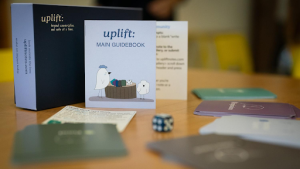
One of the things Fred kept telling us in HCD was: Fall in love with the problem, not the solution. But I only learned what he really meant by building Uplift. Don’t get attached to what you’ve made, because you’ll definitely need to fix it—and you have to be okay with that.
But it doesn’t stop there. You’ve got to keep looking for the problems. Which can be really hard—especially if you’re a perfectionist like most of us at the 5Cs. It can feel like failing to keep staring at the problem, because you’re thinking you should’ve solved it already. But to get something right, you need to keep loving the problem—even after you’ve already built your product. I’ve already taken Uplift to market, but I’m still trying to find out what it’s like for my customers to use it, and which needs it isn’t meeting—so I can keep making it better.
Uplift came out of what I learned as a neuroscience student and a designer: the range of things can make it hard to have a conversation. Maybe you’re a high school student visiting your grandfather at a senior home, or maybe you haven’t talked to him in 10 years. Maybe you’re shy or introverted like me. And on the other side, you have a person who may be experiencing cognitive decline, or is hard of hearing, or can’t see well: and all these things are barriers I tried to solve for. Uplift gives people the tools to make this connection. You open the box, roll a die and start a conversation.
written by Dan Coleman
published by Salina Muñoz
Summer Hours
Mon – Thurs | 9am – 4:30pm
Friday | 9am – 3pm
Weekends | Closed
